A fully analytical controller design is proposed to tackle a periodic control problem for stable linear systems with an input delay. Applying the internal model control scheme, the controller design reduces to designing a filter, which is done through placement of poles and zeros. The zeros are placed to compensate for the harmonics and to gain the filter properness. For placing the poles, a quasi-optimal procedure is proposed utilizing the standard LQR method. Supposing high-dimensionality of the filter due to targeting large number of harmonics, the design as well as controller implementation is performed over a state space representation. A thorough experimental case study is included to demonstrate both the practical feasibility and effectiveness of the proposed control design. The experimental validation is performed on a physical system where the goal is to reject periodic vibrations acting on a mass-spring-damper setup where the sensor and the actuator are non-collocated.
You may also like

The paper presents a controller design for systems suffering from multi-harmonic periodic disturbance and substantial input time-delay. It forms an alternative approach […]
A combination of analytical and numerical time-delay-system spectrum-shaping tools are applied to the design of the robust delayed resonator. First, the delayed […]
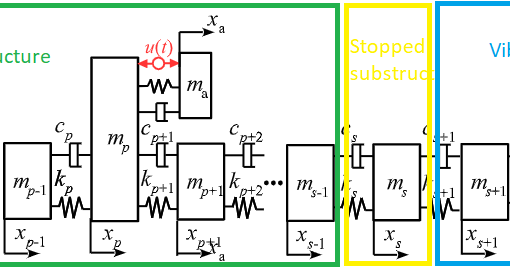

A generally applicable spectral design of non-collocated vibration suppression performed primarily by a delayed resonator is presented. The vibration suppression is achieved […]